KIVIUK.ART
Acoustic Archaeology:
Digital Reconstruction and Auralisation of the Odesa Transfiguration Cathedral.
How accurately can a custom feedback delay network (FDN) coded in Pure Data recreate the calculated historical acoustics of a destroyed church heritage site?
1. ARTIST IDENTITY
Yuliia Kiviuk is a Ukrainian sound designer, music producer, and DJ. Her artistic practice operates at the intersection of cultural preservation, spatial audio, and engineering. With a foundational Bachelor’s degree in Systems Engineering from Ukraine, she recently graduated from the SAE Institute Liverpool and is preparing to begin her MSc in Sound Design at the University of Edinburgh.Deeply connected to her roots, Yuliia works to preserve Ukrainian heritage by giving forgotten folk songs a modern context through original electronic production. Her recent track "Oi Tam," released under her alias DJ TREEXY, entered regular rotation on Kiss FM, Ukraine's premier dance radio station.She actively contributes to Ukrainian charity events as a sound technician and performer, and is currently developing "LASTIVA" — an independent record label designed to support displaced artists and bridge diverse cultures through music.While developing her bachelor's major project, Yuliia discovered a profound interest in archaeoacoustics. This research shifted her focus toward the digital preservation of cultural heritage. Her primary long-term goal is to design immersive spatial audio installations that reconstruct the acoustic environments of destroyed historical sites worldwide, ensuring that the physical loss of architecture does not mean the loss of its unique sonic identity.
2. THE WORK
Medium: Digital Acoustic Reconstruction and Auralisation.Materials: Historical architectural blueprints, calculated material absorption coefficients (marble, glass, and painted plaster), and mathematical acoustic formulas (modified Sabine equation with air attenuation).Dimensions: Spatial dimensions are based on the Upper Church's total air volume of 40,764.4 m3 and the 77-meter central dome. Temporal dimension: A calibrated reverberation time (RT60) of approximately 6.1 seconds at 1000 Hz.Tools & Software: Pure Data (plugdata) for programming the custom 4-channel Feedback Delay Network (FDN), Room EQ Wizard (REW) for analytical measurement, and Ableton Live for final audio convolution.




The Physical Loss of Sound.
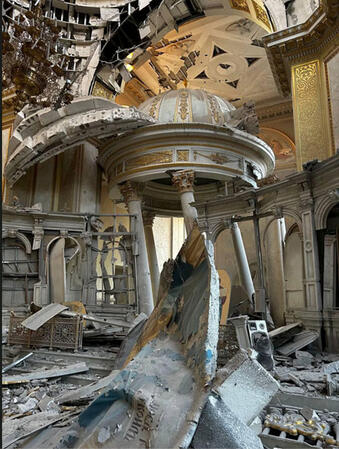
The Odesa Transfiguration Cathedral before and after the 2023 missile strike.
The destruction radically altered its massive volume and structural boundaries, erasing its original acoustic signature.


The Digital Architecture.
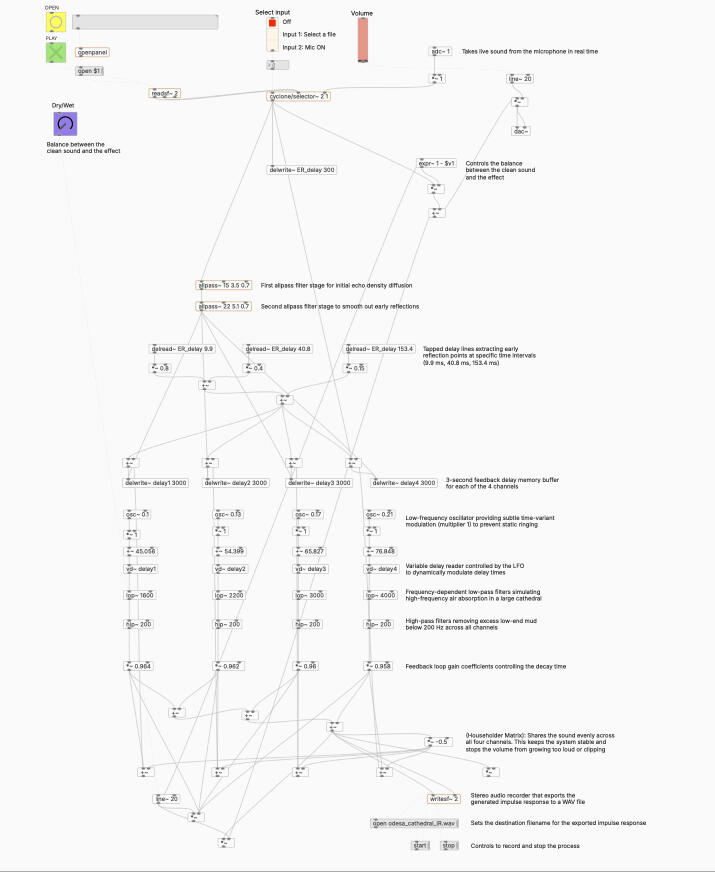
A custom 4-channel Feedback Delay Network (FDN) programmed in Pure Data.
This visual code translates the cathedral's physical dimensions, material absorption coefficients, and air attenuation into a living spatial audio engine.
Acoustic Validation.
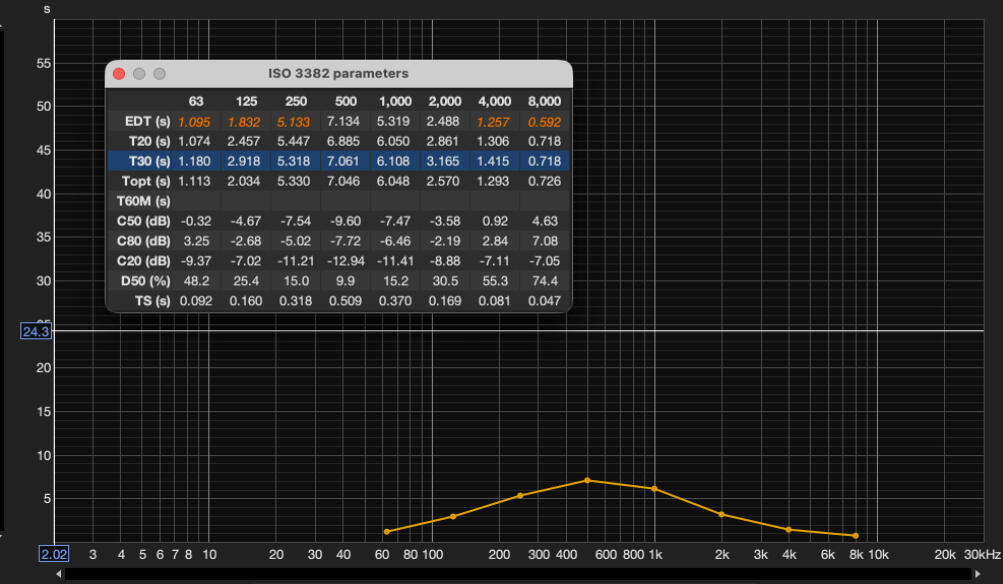
Analytical measurement of the generated impulse response using Room EQ Wizard.
The system was carefully calibrated to achieve a natural reverberation time (RT60) of approximately 6.1 seconds at 1000 Hz, matching the calculated historical acoustics.
Practical Auralisation.
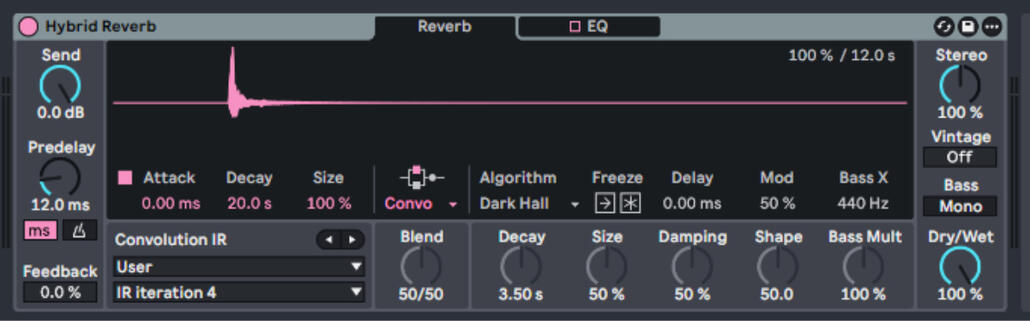
Implementing the generated acoustic impulse response into Ableton Live using a convolution reverb.
This final step bridges academic research and modern sound design, allowing the calculated historical acoustics to be applied directly to dry audio for music production and immersive installations.